
Your sales page has a headline, benefits, testimonials, an FAQ, and a call to action.
So on paper, the sales page looks complete. But that doesn’t mean every part is doing its job.
A headline can sound strong and still fail to pull the right buyer in.
Testimonials can look impressive but prove the wrong thing.
And a call to action can be perfectly clear even when the reader still isn’t ready to click.
That’s why understanding the anatomy of a sales page means more than knowing which sections to include.
Each part has a specific job. And when those parts work together, they help move the buyer from interest to belief and closer to the sale.
In this article, you’ll learn the eight main parts of a sales page and what each one needs to do.
Having all the right pieces is only the beginning. What matters is whether they work together to help the buyer say YES.
1. Headline: Give the Right Buyer a Reason to Keep Reading
The headline has one main job: make the right person want to read the next line.
That means it needs to do more than sound clever or catchy.
A strong headline should quickly show the buyer that the sales page is relevant to them.
It might point to:
- a problem they want solved,
- a result they want, or
- an idea that makes them curious enough to keep going.
The goal is not to explain the whole offer in one sentence.
It is to earn attention and open the door to the rest of the sales message.
If the headline feels vague, too broad, or disconnected from what the buyer cares about, the rest of the sales page may never get a chance to do its job.
So when you look at a headline, ask one simple question:
Does this give the right buyer a good reason to keep reading?
If the answer is no, that is the first place the sales page can start losing the sale.
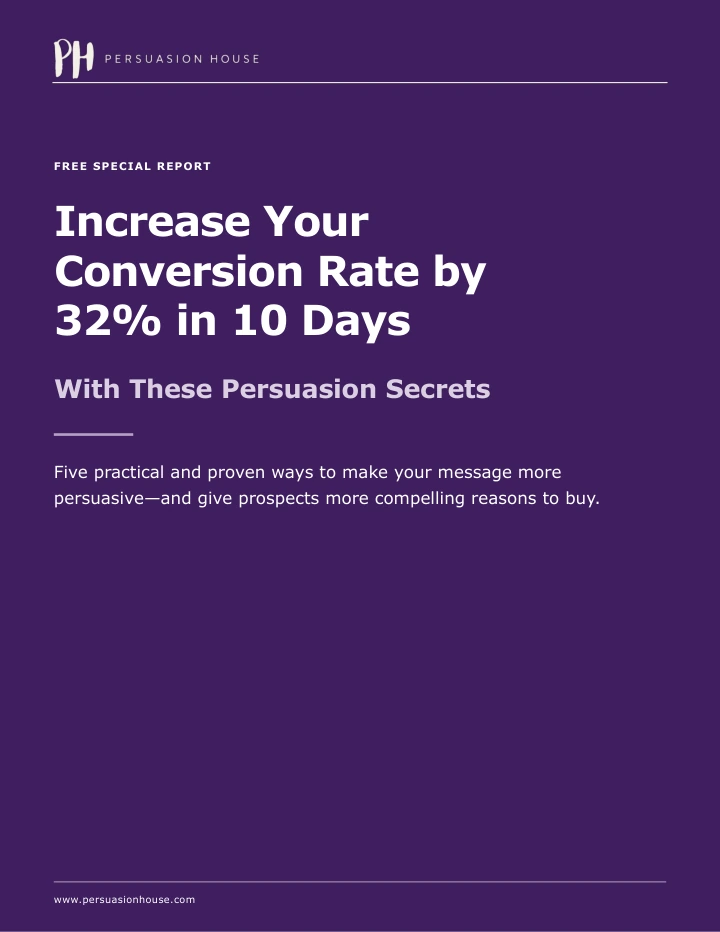
Discover 5 Persuasion Secrets to Increase Your Conversion Rate
Find out what makes interested prospects hesitate—and how to turn them into paying customers.
2. Lead: Turn Attention Into Interest
The headline gets the buyer to stop, and the lead gives them a reason to stay.
This is where the sales page starts the conversation promised by the headline.
A strong lead might:
- bring up a problem the buyer knows well,
- show them a result they want, or
- introduce an idea that makes them see their situation differently.
Whatever approach it takes, the lead should make one thing clear: this sales page is worth your time.
It should also prepare the buyer for what comes next.
If the headline makes a promise but the lead suddenly goes in another direction, interest can disappear fast.
So the headline and lead need to work together.
The headline opens the door. The lead gives the buyer a reason to walk through it.
Ask:
Does the lead make the buyer want to know what comes next?
If not, the sales page may lose them before it ever gets to the offer.
3. Show the Buyer You Understand What’s at Stake
Once the buyer is interested, the sales page needs to show that you understand the problem they are dealing with.
This is more than simply naming the problem.
A strong sales page shows:
- what the issue is costing them,
- how it affects their day-to-day life or business, and
- why leaving it unsolved can keep creating frustration.
The goal is not to make the problem sound worse than it is.
It is to help the buyer see that their problem is real, important, and worth fixing.
The buyer should feel understood rather than sold to.
Ask:
Does this sales page make the buyer feel that we understand the problem they want solved?
If not, the sales page may struggle to make the solution feel relevant.
4. Show the Buyer a Better Way Forward
Once the problem is clear, the sales page needs to show the buyer that there is a way to solve it.
This is where the sales page introduces the main idea behind your solution.
The goal is not to jump straight into features or everything the buyer gets. First, help them understand how your approach solves the problem they just read about.
A strong sales page should make the buyer think, “That makes sense. This could work for me.”
It should also make your approach feel different from the other options they may have seen or tried before.
That gives the offer a reason to exist.
Ask:
Does this sales page help the buyer understand why this solution could solve their problem?
If not, the offer that follows may feel like just another product or service.
5. Make the Value Easy to See
Once the buyer understands the solution, the sales page needs to show them exactly what they get.
This is where the buyer sees exactly what they’re getting.
A strong sales page should explain:
- what is included,
- how it helps, and
- why it is worth the price.
The key is not to dump a list of features on the buyer.
Each part of the offer should connect back to something they care about, whether that is saving time, solving a problem, getting a better result, or avoiding a costly mistake.
The buyer should come away thinking, “I understand what I’m getting and what it can do for me.”
Ask:
Does this sales page make the value of the offer easy to understand?
If not, even an interested buyer may struggle to see why they should move forward.
6. Give the Buyer a Reason to Believe You
By this point, the buyer understands the problem, the solution, and the offer.
Now they need a reason to believe your promises.
That is the job of proof.
Testimonials, case studies, results, demonstrations, reviews, and specific numbers can all help. But simply adding them to the sales page is not enough.
The proof needs to support the promises the buyer is most likely to question.
If you promise a certain result, show evidence that the result is possible.
If buyers wonder whether the solution works for people like them, use a customer story they can relate to.
Good proof makes the offer feel less like a promise and more like something the buyer can trust.
Ask:
Does the proof support the promises the buyer needs to believe?
If not, the buyer may understand the offer and still hesitate to act.
7. Remove the Reasons to Hesitate
Even when the buyer likes the offer, they may still have doubts.
They may wonder:
- whether the solution will work for them,
- whether the price is worth it,
- whether now is the right time, or
- whether they can trust the company behind the offer.
A strong sales page does not ignore those questions.
It answers them before they become reasons not to buy.
That does not mean adding a long FAQ just because you keep seeing one in successful sales page examples.
Some prospects need more answers than others. That is why a long form sales page should be long enough to help them decide.
The goal is to deal with the concerns that are most likely to stop the sale.
Sometimes that takes a direct answer. Other times, proof, a guarantee, a customer story, or a clear explanation can do the job better.
Ask:
Does the sales page answer the doubts that could stop an interested buyer from saying YES?
If not, those unanswered questions can become the reason they walk away.
8. Call to Action: Make the Next Step Obvious
Once the buyer understands the offer, believes the promises, and has fewer doubts, the sales page needs to tell them what to do next.
That is the job of the call to action.
A strong call to action should be clear, specific, and easy to follow.
It should tell the buyer exactly what happens next, whether that means buying, booking a call, starting a trial, or filling out a form.
If the sales page asks for the sale before the buyer has enough reason to act, the call to action can feel rushed. If it waits too long, the buyer may lose momentum.
The best call to action feels like the natural next step after everything the sales page has already shown them.
Ask:
Does the call to action make it clear what the buyer should do next?
If not, even a convinced buyer may hesitate at the final step.
The Parts Only Work When They Work Together
A sales page can have every part on this list and still fall short.
The challenge is making sure every part earns its place on the sales page.
Each one needs to do its job at the right time and help the buyer move naturally to the next part.
When that happens, the sales page stops feeling like a collection of separate parts and starts feeling like one clear sales conversation.
And yes, there’s a lot to get right.
You need to understand the buyer… make the right promise… explain the offer… back up your promises… deal with doubts… and bring everything together in a way that feels natural.
The good news is you don’t have to figure all of that out on your own.
At Persuasion House, we understand how the anatomy of a sales page needs to work as a whole.
We can help you bring those parts together into a sales page that makes a strong case for your offer and gives buyers a reason to keep moving toward the sale.
If your sales page has all the right parts but still isn’t bringing in enough sales, the problem may be the strategy behind the sales page rather than the sections themselves.