
Your ads are running, your email campaigns are driving clicks, and traffic is reaching the sales page.
Yet too many prospects are still leaving without buying.
So naturally, you start looking at the copy.
Maybe the headline needs a stronger hook… the lead takes too long to get to the point… or the call to action needs another rewrite.
But what if the words aren’t the real problem?
When a sales page falls short, the real problem may be the strategy behind the sales page, not the writing itself.
If you don’t know your buyer well enough, it’s hard to say what truly matters to them.
If your offer sounds like everything else on the market, readers have little reason to choose it.
And if you make big claims without enough proof, they may simply not believe you.
Any one of those problems can hurt the sale, even when the writing itself is clear and polished.
That’s why writing a sales page should begin with strategy, not sentences.
In this article, you’ll learn how to find the real reason your sales page is underperforming before you rewrite the copy.
Before you change the words, you need to know what’s getting in the way of the sale.
Start With the Buyer
Before the copy is rewritten, get clear on who the sales page needs to persuade:
- What does your buyer want most?
- What are they frustrated with?
- What have they already tried?
- What are they skeptical about?
- What would have to become true in their mind before buying feels like the right move?
The answers should come from real customer language whenever possible.
If the buyer research is weak, the sales page may end up talking about what your company wants to say instead of what the prospect needs to hear.
That’s a hard problem to fix with better wording.
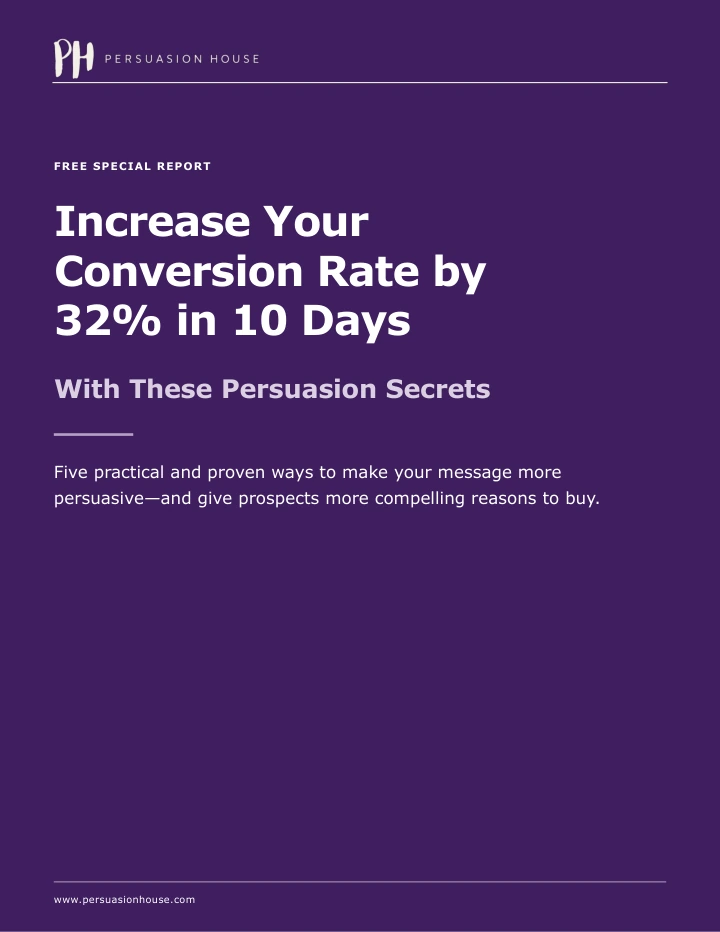
Discover 5 Persuasion Secrets to Increase Your Conversion Rate
Find out what makes interested prospects hesitate—and how to turn them into paying customers.
Find the Belief That Makes the Sale Possible
Every sales page asks the reader to believe something.
Not just that your product has useful features. Something deeper …
… maybe they need to believe their current approach is costing them more than they realize.
… maybe they need to believe your solution can work where others failed.
… or maybe they need to believe solving the problem now is worth the effort and expense.
That central belief should shape the entire sales page.
Your headline, lead, proof, offer, and call to action should all help move the reader toward the same conclusion.
When a sales page tries to sell too many ideas at once, the message gets muddy.
Give Buyers a Reason to Choose You
A sales page can explain an offer perfectly and still make it sound ordinary.
Before the sales page gets into features and benefits, a few harder questions need answers:
- Why this solution?
- Why your company?
- Why now?
- Why should the buyer choose this instead of doing nothing, sticking with what they already use, or choosing a competitor?
The goal is not simply to explain what you sell.
It’s to help the reader understand why your offer is the right fit for their situation.
If that is unclear, polished copy may only make an ordinary offer sound more polished.
Build the Case Before the Copy
Each part of a sales page should help the reader understand the next one.
The sales page can start with a strong promise about the problem you solve or the result you offer.
But making a promise is not enough.
The reader still needs to know why they should believe you… they need proof… they need their doubts answered… and they need a clear reason to keep reading…
How much room the sales page needs to do all of that depends on the prospect, which is why a long form sales page has no magic word count.
Once the sales page answers one question, it can lead them to the next point they need to understand.
That is what keeps the sales page moving.
Each idea should build on the one before it, until buying feels like a natural next step instead of a sudden sales pitch.
Understanding the anatomy of a sales page matters, but having all the “right” sections is not enough.
You can have a headline, benefits, testimonials, an FAQ, and a call to action and still lose the reader.
If those parts do not work together, you do not have a strong sales message.
Put Proof Where Doubt Is Highest
Most businesses know they need testimonials, case studies, numbers, or other forms of proof.
But proof is not decoration.
Its job is to make important claims easier to believe.
So instead of asking, “Where should we put the testimonials?” ask:
Where is the reader most likely to doubt us?
If the sales page makes a bold performance claim, support it there.
If the buyer questions whether the solution works for someone like them, use a relevant customer story.
If the offer feels risky, reduce that risk with evidence, guarantees, demonstrations, or specifics.
The stronger the claim, the more support it usually needs.
Know What Needs Fixing
At this point, the main question is simple:
Is the problem what we’re saying, or how we’re saying it?
Those are two very different problems. If the message itself is wrong, better wording will only make the wrong message sound better.
But if the message is right, then the writing may be what needs work. It may need to be clearer, more convincing, or easier to act on.
That’s why random changes—or blindly borrowing ideas from successful sales page examples—usually get you nowhere.
The real job is to find out what’s getting in the way first. Only then does it become clear what needs to change.
Get the Strategy Right First
If people are already reaching your sales page but too many leave without buying, more traffic may not be the answer.
The problem could be what they find when they get there.
That’s why writing a sales page that sells more starts before anyone changes the headline, opening, or call to action.
First, you need to get clear on the message behind the sales page:
What your buyer cares about, what they need to believe, why your offer is the right choice, what proof they need, and what might stop them from buying.
At Persuasion House, we put all of that thinking into what we call a Persuasion Strategy.
It gives us a clear plan for what the sales page needs to say and why.
Then we use that plan to rewrite the sales page around a stronger message, stronger proof, and a smoother path to the sale.
If your sales page is getting attention but not enough sales, we can help you with writing a sales page that gives buyers a more compelling reason to say yes.